
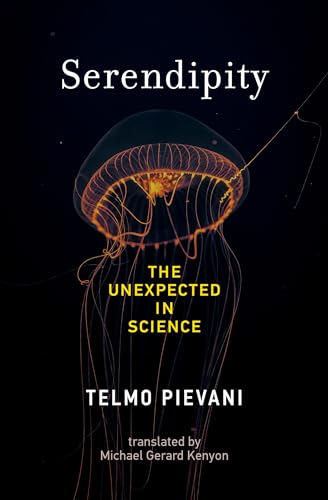
Serendipity : THE UNEXPECTED IN SCIENCE / Telmo Pievani ; translated by Michael Gerard Kenyon.
Material type: TextCambridge, Massachysetts : The MIT Press, 2024Description: 215 pages ; 21 cmContent type:
 - text
- unmediated
- volume
- 9780262049153
- 23 576.509 TEL
| Item type | Current library | Collection | Call number | Copy number | Status | Date due | Barcode |
|---|---|---|---|---|---|---|---|
 Book
Book
|
Perpustakaan MBIP Medini General Stacks | Non-Fiction book | 576.509 TEL 2024 c.1 (Browse shelf(Opens below)) | 1 | Available | 00001282 |
Browsing Perpustakaan MBIP Medini shelves, Shelving location: General Stacks, Collection: Non-Fiction book Close shelf browser (Hides shelf browser)

|

|

|

|

|

|

|
||
| 551.6 SA 2023 c.1 Breathe Tackling the Climate Emergency / | 551.6095 CRE 2019 c.1 Creating future-proof cities : how to navigate the climate crisis / | 576.509 JAC 2022 c.1 The logic of life : a history of heredity / | 576.509 TEL 2024 c.1 Serendipity : THE UNEXPECTED IN SCIENCE / | 577 TRA 2013 c.1 PRINCIPLES OF ECOLOGICAL LANDSCAPE DESIGN / | 577.0959 BUK 2020 c.1 BUKIT FRASER : KEPELBAGAIAN BIOLOGI & PERSEKITARAN FIZIKAL / | 579.0959 NUR 2019 c.1 RUMPAI LAUT JOHOR / |
Includes bibliographical references and index.
From the bestselling author of Imperfection, a theory of uncertainty as the very core of the scientific method—and the essence of its wonder.
How many times have we looked for something and found something else? A partner, a job, an object? The same thing happens often to scientists: they design an experiment and discover the unexpected, which usually turns out to be very important. This fascinating phenomenon is called serendipity, which takes its name from the mythical Serendib, a place from which, according to a Persian fable, three princes set off to explore the world, making chance discoveries along the way. In Serendipity, the award-winning author of Imperfection Telmo Pievani returns to weave a compelling story about the unexpected in science and its fascinating role in our understanding of the world.
Going far beyond the usual examples of penicillin, X-rays, the microwave oven, and Christopher Columbus, Pievani shows that the most surprising stories of serendipity in the history of science reveal profound aspects of the logic of scientific discovery. In this book, he presents for the first time: an archaeology of the idea; a taxonomy of serendipitous discoveries; an “ecology of serendipity” (the surrounding conditions and factors that can promote it); and lastly, a theory of serendipity (why it occurs so frequently in so many sciences). From Zadig to Sherlock Holmes, Pievani shows that such great discoveries are not just the product of luck. Instead, serendipity comes from a mix of cunning, curiosity, sagacity, imagination, and accidents caught on the fly. Serendipity illuminates how much we don’t know and how much we don't even know we don't know. Above all, Pievani reminds us that the human brain is of a piece with the world it is investigating—a world so much bigger than our knowledge—and it has also evolved within that world, adapting as it has to.
Click on an image to view it in the image viewer
There are no comments on this title.